

IMPORTANT INFORMATION
All data as at 31 December 2025, unless specified otherwise. This document is issued for information purposes only. It does not constitute the provision of financial, investment or other professional advice. We strongly recommend you seek independent professional advice prior to investing. The value of investments and the income derived from them may fall as well as rise. Investors may not get back the amount originally invested and may lose money. Any forward-looking statements are based on CCLA’s current opinions, expectations and projections. CCLA undertakes no obligations to update or revise these. Actual results could differ materially from those anticipated. All names, logos and brands shown in this document are the property of their respective owners and do not imply endorsement. These have been used for the purposes of this document only. CCLA Investment Management Limited (registered in England & Wales, No. 2183088, at One Angel Lane, London EC4R 3AB) is part of the Jupiter Group, and is authorised and regulated by the Financial Conduct Authority.

Foreword
What is Good Investment?
Our responsible investment approach
2025 a year in action
Stewardship and engagement
Appendix 1: 2025 engagement record
Appendix 2: Shareholder proposals
Appendix 3: Investors supporting CCLA engagement
Appendix 4: Governance and our portfolios
Appendix 5: Climate pledge and portfolio carbon footprint
Appendix 6: Memberships and initiatives
Appendix 7: Industry recognition
Appendix 8: Standards, frameworks and initiatives

2026 Better World
Stewardship outcomes for the year 2025
Share





result
Appendices
Appendix 1: 2025 engagement record
Appendix 1: 2025 engagement record
The following table includes direct engagement, all CCLA-led collaborative engagement and third-party-led engagement where we have portfolio holdings.


Appendix 2: Shareholder proposals
Appendix 2: Shareholder proposals
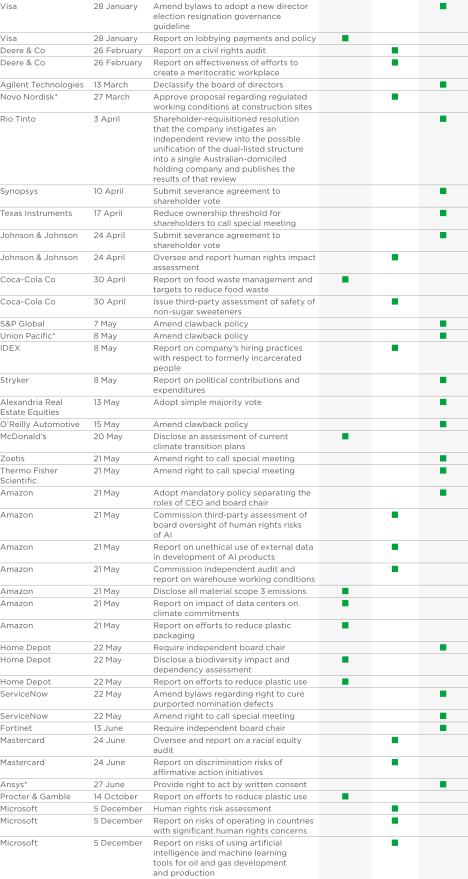
The table below shows CCLA’s ‘for’ votes in 2025.
All of these votes took place at annual general meetings.

Appendix 3: Investors supporting CCLA engagement
Appendix 3: Investors supporting CCLA engagement
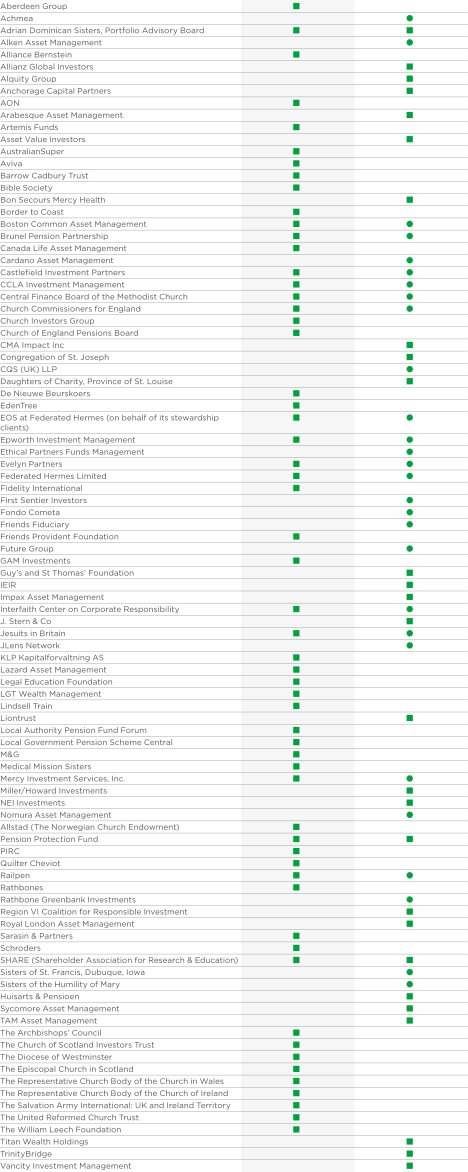
We aim to mobilise the investment industry into action. Here we summarise institutional investor support for CCLA stewardship initiatives as at the end of 2025.



www.CartoonStock.com
Appendix 4: Governance and our portfolios
Appendix 4: Governance and our portfolios
Corporate governance is the system by which companies are directed and controlled. A board of directors is responsible for the governance of a company. The role of shareholders is to appoint the directors and auditors to satisfy themselves that an appropriate governance structure is in place.
Good corporate governance generally requires the following:
- a well-functioning board that can both lead and control the business, nurturing its long‑term success
- effective sub-committees (reporting to the board): nomination, remuneration and audit (and risk)
- executive remuneration that aligns the interests of the directors with the long-term interests of the company and its shareholders.
Governance evaluation process
Governance evaluation process
We use a bespoke quantitative corporate governance rating tool, designed to assess companies’ board structure, ownership, accounting practices and management capabilities.
The box below details what each theme assesses and how these themes are weighted. A secondary, qualitative overlay (see below) allows us to identify strengths and weaknesses in a company’s governance structure and how these evolve over the life of the holding.
OUR Governance evaluation process
We score and weight companies on the following themes:
0
%
capital stewardship
Assesses the quality of management and its ability to generate cash and manage growth
0
%
accounting
Assesses the quality of the company’s financial statements and its accounting
0
%
board composition
Assesses the quality of the individuals, their independence and their track record
0
%
shareholder rights
Assesses the ownership structure of the company
Corporate governance and the investment process
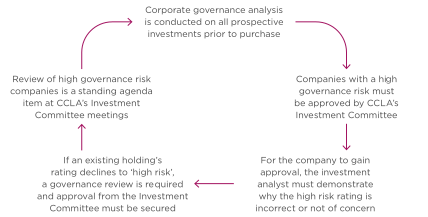
Governance evaluation is an integral part of our investment process for listed equities and operates as follows:
Our proprietary governance rating
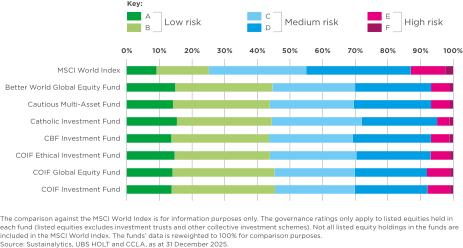
Using a proprietary quantitative corporate governance rating tool, we award all companies a governance rating from A (best) to F (worst). High‑risk companies (i.e. those rated E or F) are not permissible investments without the approval of CCLA’s Investment Committee.
Appendix 5: Climate pledge and portfolio carbon footprint
Appendix 5: Climate pledge and portfolio carbon footprint
Our climate pledge
Our climate pledge
At CCLA, we believe that climate change is a systemic risk to the global economy. Unmitigated, it poses a significant financial risk not only to the value of our clients’ investments over the long term but also to our collective way of life.
While our approach may differ from that of other parts of the industry, we remain committed to achieving net-zero emissions on the listed equities within our portfolios by no later than 2050.xxi We believe that this requires us to take care in asset selection and to use our tools as an investor to incentivise an accelerated energy transition.
We are committed to playing our part in developing an approach to managing the risks and opportunities associated with climate change, reflecting the need for urgent action and the role we see for ourselves as a catalyst for change in our industry.
Commitment to net zero
Commitment to net zero
The Net Zero Asset Managers initiative is an international group of asset managers committed to supporting the goal of net-zero greenhouse gas emissions. As a founding member, we commit to managing our listed equity investments to a carbon footprint that is below a decreasing maximum ceiling.
Our approach to setting targets is based on the scientific findings of the Intergovernmental Panel on Climate Change (IPCC) special report ‘Global warming of 1.5 °C’ and the United Nations Environment Programme (UNEP) ‘Emissions gap report 2020’, combined with the information contained in various investor networks. In developing these targets, we seek to acknowledge the systemic nature of climate change and the developing nature of the science and methodologies used to determine how to achieve global alignment on a maximum temperature change of 1.5 °C. The chart below illustrates our approach.
Setting net-zero targets
Source: MSCI and CCLA as at 31 December 2025.
The first, and upper, threshold is a non-linear decarbonisation rate representing a 7.6% per annum emissions reduction. This is aligned with the European Union’s requirements for benchmarks aligned with the 2015 Paris Agreement and is derived from the UNEP gap report, using 2018 as the base year. The second, more ambitious threshold is derived from the reductions required to approximately halve global emissions by 2030 and reach net zero by 2050, as set out in the IPCC special report, also using 2018 as the base year. We have altered the trajectory to represent a combination of example pathways in the IPCC special report so as to ultimately target a 50% reduction in emissions by 2025.
The shaded area between these two decarbonisation rates reflects that the definition and development of scenarios aligned with the target warming limit of 1.5 °C are still evolving. We aim to use the best available methodology to determine an appropriate ceiling for our listed equity investments’ emissions.
Additionally, we acknowledge that such targets are subject to recalculation on an ad hoc basis in the event of material developments in climate science and the underlying assumptions and methodologies of scenarios aligned with maximum warming of 1.5 °C. Such recalculations will ensure that targets remain representative of the best available science.
We will review our targets in the forthcoming year against new best practice set by the Institutional Investors Group on Climate Change’s Net Zero Investment Framework. In line with the best available science on the impacts of climate change, we acknowledge that there is an urgent need to accelerate the transition towards global net-zero emissions and for asset managers to play a part to help deliver the goals of the Paris Agreement and ensure a just transition. For full details, see our report ‘A climate for Good Investment’.
Lynn Hsu/The New Yorker Collection/The Cartoon Bank
Fund carbon measurements
*CBF Global Equity Fund held in the CCLA Better World Global Equity Fund.
Source: MSCI ESG Manager, 31 December 2025. Fund metrics relate to equity holdings only and include scope 1 and 2 emissions. CO2e: carbon dioxide equivalent. All data refers to listed equity holdings only. In each case the equity section has been reweighted to 100% of holdings.
Appendix 6: Memberships and initiatives
Appendix 6: Memberships and initiatives
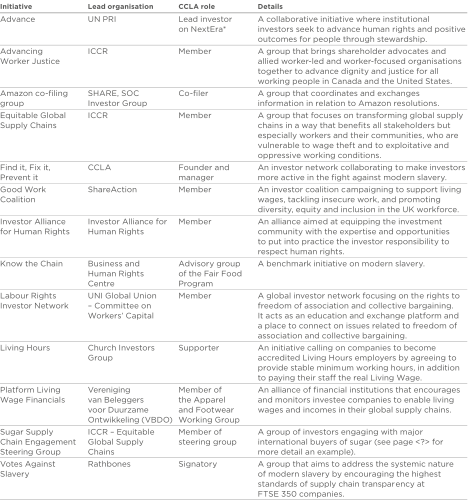
We believe that collaborative action strengthens our engagement approach, as exemplified by our engagement collaborations and membership of key thematic initiatives. A full list is provided below.
Better work
Better work
Better environment
Better environment
Better health
Better health
Appendix 7: Industry recognition
Appendix 7: Industry recognition
While investing sustainably is a priority for many, evaluating the approach of institutional asset managers remains a challenge.
We recognise the importance of credible industry standards such as the UN Principles for Responsible Investment’s annual assessment process and the Financial Reporting Council’s UK Stewardship Code.
As we are a signatory to both, our approach is assessed regularly. The full results are available on our website.
UK Stewardship Code
UK Stewardship Code
We have been accepted as a signatory to the Financial Reporting Council’s UK Stewardship Code 2020. The code sets out 12 principles that aim to establish high stewardship standards for those investing money on behalf of UK savers. See our website for our response for 2024–2025.
Principles for Responsible Investment
Principles for Responsible Investment
The United Nations-supported Principles for Responsible Investment is the world’s leading proponent of responsible investment.
CCLA’s ratings for 2025 are set out below and available on our website.
www.CartoonStock.com
Appendix 8: Standards, frameworks and initiatives
Appendix 8: Standards, frameworks and initiatives
Following are further details on the major standards, frameworks and initiatives referenced throughout this report.
Standard, framework or initiative
Reference
Access to Medicine Foundation
See https://accesstomedicinefoundation.org
Access to Nutrition index (ATNi)
See https://accesstonutrition.org
Advance
Principles for Responsible Investment (2026), ‘Advance’, online at https://public.unpri.org/investment-tools/stewardship/advance
Advancing Worker Justice
Interfaith Center on Corporate Responsibility (2026), ‘Advancing Worker Justice’, online at www.iccr.org/advancing-worker-justice
Antimicrobial Resistance Benchmark
Access to Medicine Foundation (2026), ‘Antimicrobial Resistance Benchmark’, online at https://accesstomedicinefoundation.org/sectors-and-research/amr-benchmark
Business Benchmark on Farm Animal Welfare (and Global Investor Collaboration on Farm Animal Welfare)
See www.bbfaw.com
CCLA Corporate Mental Health Benchmark
CCLA (2026), ‘Mental health’, online at www.ccla.co.uk/mental-health
CCLA Modern Slavery Benchmark
CCLA (2026), ‘Modern slavery’, online at www.ccla.co.uk/sustainability/initiatives/modern-slavery
CDP
See www.cdp.net/en
Climate Action 100+
See www.climateaction100.org
Corporate Human Rights Benchmark
World Benchmarking Alliance (2026), ‘Corporate Human Rights Benchmark’, online at www.worldbenchmarkingalliance.org/benchmark/corporate-human-rights-benchmark
Corporate Sustainability Due Diligence Directive (CSDDD)
Directive (EU) 2024/1760 of the European Parliament and of the Council of 13 June 2024 on corporate sustainability due diligence and amending Directive (EU) 2019/1937 and Regulation (EU) 2023/2859, online at https://eur-lex.europa.eu/eli/dir/2024/1760/oj
Corporate Sustainability Reporting Directive (CSRD)
Directive (EU) 2022/2464 of the European Parliament and of the Council of 14 December 2022 amending Regulation (EU) No 537/2014, Directive 2004/109/EC, Directive 2006/43/EC and Directive 2013/34/EU, as regards corporate sustainability reporting, online at https://eur-lex.europa.eu/eli/dir/2022/2464/oj/eng
Deforestation Regulation
Regulation (EU) 2023/1115 of the European Parliament and of the Council of 31 May 2023 on the making available on the Union market and the export from the Union of certain commodities and products associated with deforestation and forest degradation and repealing Regulation (EU) No 995/2010, online at https://eur-lex.europa.eu/legal-content/EN/TXT/?uri=CELEX%3A02023R1115-20241226
Employer Pays Principle
Institute for Human Rights and Business (2025), ‘The Employer Pays Principle’, online at www.ihrb.org/projects/employer-pays-principle
Equitable Global Supply Chains
Interfaith Center on Corporate Responsibility (2026), ‘Equitable Global Supply Chains’, online at www.iccr.org/equitable-global-supply-chains
FAIRR Initiative’s investor network
See www.fairr.org
Financing a Just Transition Alliance
Grantham Research Institute on Climate Change and the Environment (2025), ‘Financing a just transition’, online at www.lse.ac.uk/granthaminstitute/financing-a-just-transition
Find it, Fix it, Prevent it
CCLA (2026), ‘Modern slavery’, online at www.ccla.co.uk/sustainability/initiatives/modern-slavery
Global Compact
See https://unglobalcompact.org
Global Investor Coalition on Workplace Mental Health
CCLA (2024), ‘Global investor statement on workplace mental health’, online at www.ccla.co.uk/documents/global-investor-statement-workplace-mental-health/download?inline
Global Reporting Initiative
See www.globalreporting.org
Good Work Coalition
ShareAction (2026), ‘Fair treatment of workers’, online at https://shareaction.org/global-issues/good-work
Guidelines for Multinational Enterprises on Responsible Business Conduct
Organisation for Economic Co-operation and Development (2023), ‘OECD guidelines for multinational enterprises on responsible business conduct’, online at www.oecd.org/content/dam/oecd/en/publications/reports/2023/06/oecd-guidelines-for-multinational-enterprises-on-responsible-business-conduct_a0b49990/81f92357-en.pdf
Guiding Principles on Business and Human Rights
United Nations Human Rights Office of the High Commissioner (2011), ‘Guiding principles on business and human rights’, online at www.ohchr.org/sites/default/files/documents/publications/guidingprinciplesbusinesshr_en.pdf
Healthy Markets Initiative
ShareAction (2026), ‘Healthy Markets Initiative’, online at
https://shareaction.org/investor-initiatives/healthy-markets-initiative
InfluenceMap
See https://influencemap.org
Investor Alliance for Human Rights
See https://investorsforhumanrights.org
Investor Coalition on Food Policy
Food Foundation (2026), ‘The Investor Coalition on Food Policy’, online at https://foodfoundation.org.uk/initiatives/investor-coalition-food-policy
Investor Expectations on Nutrition, Diets and Health
Access to Nutrition initiative (2020), ‘Investor Expectations on Nutrition, Diets and Health’, online at https://accesstonutrition.org/app/uploads/2020/06/Investor-Expectations-on-Nutrition-Diets-and-Health-FINAL.pdf
Investor Statement on Technology, Mental Health and Well-being
Sycomore AM (2025), ‘Investor Statement on Technology, Mental Health and Well-being’, online at https://en.sycomore-am.com/download/372480158
Know the Chain Benchmark
Business and Human Rights Centre (2021), ‘KnowTheChain’, online at
www.business-humanrights.org/en/from-us/knowthechain
Labour Rights Investor Network
Committee on Workers’ Capital (2026), ‘Labour Rights Investor Network’, online at www.workerscapital.org/labour-rights-investor-network
Living Hours
Living Wage Foundation (2026), ‘Living Hours’, online at www.livingwage.org.uk/living-hours
Living Wage Foundation
See www.livingwage.org.uk
Long-term Investors in People’s Health
ShareAction (2026), ‘Long-term Investors in People’s Health’, online at https://shareaction.org/investor-initiatives/long-term-investors-for-peoples-health
Nature Action 100
See www.natureaction100.org
Net Zero Asset Managers initiative
See www.netzeroassetmanagers.org
Net Zero Engagement Initiative
Institutional Investors Group on Climate Change (2026), ‘Net Zero Engagement Initiative’, online at www.iigcc.org/net-zero-engagement-initiative
Net Zero Investment Framework
Institutional Investors Group on Climate Change (2026), ‘Net Zero Investment Framework’, online at www.iigcc.org/net-zero-investment-framework
Non-Disclosure Campaign
CDP (2026), ‘Non-Disclosure Campaign’, online at www.cdp.net/en/campaigns/non-disclosure-campaign
Omnibus package
European Commission (1 April 2025), ‘Omnibus package’, online at
https://finance.ec.europa.eu/news/omnibus-package-2025-04-01_en
Paris Agreement
United Nations Climate Change (2026), ‘The Paris Agreement’, online at
https://unfccc.int/process-and-meetings/the-paris-agreement
Platform Living Wage Financials
See https://livingwage.nl
Powering Past Coal Alliance
See https://poweringpastcoal.org
Reclaim Finance
See https://reclaimfinance.org
SASB Standards
See https://sasb.ifrs.org
ShareAction and ATNi research
ATNi (2026), ‘ATNi partnership with ShareAction’, online at
https://accesstonutrition.org/project/partnership-with-shareaction
Social Transformation Framework
World Benchmarking Alliance (2026), ‘Social Transformation Framework’, online at www.worldbenchmarkingalliance.org/latest/social-transformation-framework
Spring
Principles for Responsible Investment (2026), ‘Spring’, online at
https://public.unpri.org/investment-tools/stewardship/spring
Sustainalytics ESG Risk Ratings
Sustainalytics (2026), ‘ESG risk ratings’, online at www.sustainalytics.com/esg-data
Transition Pathway Initiative
See www.transitionpathwayinitiative.org
Transition Plan Taskforce
Department for Energy Security and Net Zero (25 June 2025), ‘Transition plan requirements: implementation routes’, online at www.gov.uk/government/consultations/climate-related-transition-plan-requirements/transition-plan-requirements-implementation-routes-accessible-webpage
UK Policy Working Group
Institutional Investors Group on Climate Change (2026), ‘Investor working groups’, online at www.iigcc.org/investor-working-groups
Votes Against Slavery
Rathbones (2026), ‘Votes against slavery’, online at www.rathbones.com/en-gb/wealth-management/responsible-investment/votes-against-slavery
xxi Listed equities are share or stock holdings in companies that are tradeable on public markets. In this appendix, when referring to listed equities, we exclude listed collective vehicles (such as investment trusts, whose primary business is to invest in other companies to generate a profit) and only refer to individual companies (whose primary business is to provide a service or sell a product to generate a profit).
*Not held in CCLA portfolios as at 31 December 2025.