

IMPORTANT INFORMATION
All data as at 31 December 2025, unless specified otherwise. This document is issued for information purposes only. It does not constitute the provision of financial, investment or other professional advice. We strongly recommend you seek independent professional advice prior to investing. The value of investments and the income derived from them may fall as well as rise. Investors may not get back the amount originally invested and may lose money. Any forward-looking statements are based on CCLA’s current opinions, expectations and projections. CCLA undertakes no obligations to update or revise these. Actual results could differ materially from those anticipated. All names, logos and brands shown in this document are the property of their respective owners and do not imply endorsement. These have been used for the purposes of this document only. CCLA Investment Management Limited (registered in England & Wales, No. 2183088, at One Angel Lane, London EC4R 3AB) is part of the Jupiter Group, and is authorised and regulated by the Financial Conduct Authority.

Foreword
What is Good Investment?
Our responsible investment approach
2025 a year in action
Stewardship and engagement
Appendix 1: 2025 engagement record
Appendix 2: Shareholder proposals
Appendix 3: Investors supporting CCLA engagement
Appendix 4: Governance and our portfolios
Appendix 5: Climate pledge and portfolio carbon footprint
Appendix 6: Memberships and initiatives
Appendix 7: Industry recognition
Appendix 8: Standards, frameworks and initiatives

2026 Better World
Stewardship outcomes for the year 2025
Share





result
Better Health
CCLA Corporate Mental Health Benchmark
CCLA Corporate Mental Health Benchmark
Mental health directly affects workforce productivity, corporate performance and long-term value creation. Mental ill-health costs the global economy approximately $1 trillion annually in lost productivity, with 12 billion working days lost.

Millie Nice
Mental health is not just a moral issue but also a strategic business concern. Companies that proactively support mental health are better positioned to reduce costs, enhance performance and create sustainable value for investors.
In 2022, with the help of sustainability consultancy Chronos Sustainability, we launched the inaugural CCLA Corporate Mental Health Benchmark. The benchmark is aligned with the World Health Organization (WHO) guidelines and WHO and International Labour Organization policy brief recommendations for strengthening workplaces so they can implement effective action to protect mental health at work.
The benchmark provides a clear disclosure framework for companies and represents an important tool for investors in measuring how businesses are managing the mental health of their employees. We assess 220 listed companies annually and rank them into one of five performance tiers, across two benchmarks (UK and global). We then engage with those companies to encourage them to improve their approach. See our website for details and company rankings.
Acknowledging that it takes more than a single investment manager to bring about change at scale, we have also founded and continue to coordinate a sizeable investor coalition that supports our engagement. During the year, 56 investors, with a combined $10 trillion in assets under management, supported our engagement efforts on this theme.xvii
Workplace mental health: financial case for action
Workplace mental health: financial case for action
1,800
£
cost per employee every year due to mental ill-health
4.70
£
return for every £1 invested in employee mental health
Mental Health Benchmark in numbers
Mental Health Benchmark in numbers
Achievements to date
Achievements to date
0
companies have improved performance tier since their first assessment
0
million employees at improved companies
0
investors supporting CCLA’s engagement efforts
0
$
trillion in assets under management supporting engagement efforts
2025 UK and global benchmarks
2025 UK and global benchmarks
0
companies assessed
0
companies engaged with us
0
companies mentioned
the benchmark in their public reportingxviii
0
votes against CEO re‑election on mental health performance groundsxix
Mental Health Benchmark outcomes
Mental Health Benchmark outcomes
Top improvers by percentage change in score 2022–2025
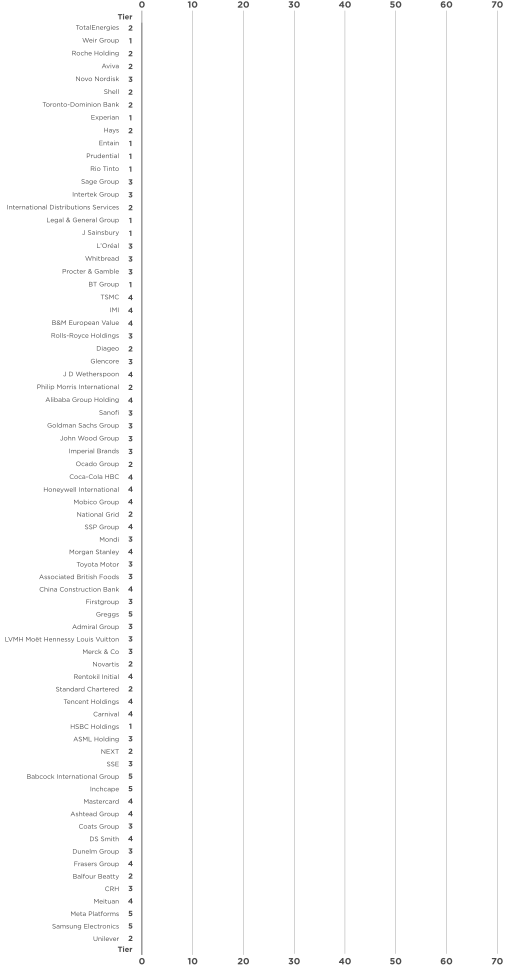
The chart below shows the companies (in both the UK benchmark and the global benchmark) that improved their score by 10 percentage points or more between 2022 and 2025. Includes each company’s first to most recent benchmark score.
Most deteriorated companies by change in score 2022–2025
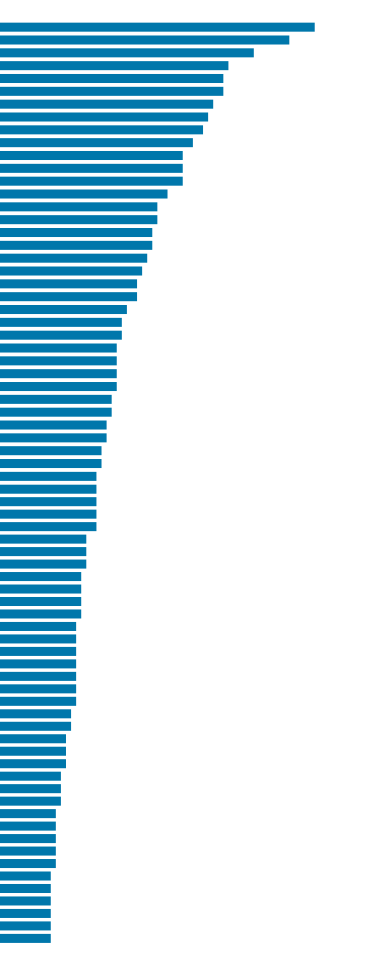
The chart below shows the companies (in both the UK benchmark and the global benchmark) whose score deteriorated by 10 percentage points or more in 2022–2025. Includes each company’s first to most recent benchmark score.
Mental health company engagement
This chart shows the number of companies engaged in the UK benchmark and the global benchmark between 2023 and 2025
Mental health benchmark case study:
Weir Group
The Weir Group is a Scottish multinational engineering company specialising in mining and minerals technology. The company was assessed as tier 4 (second-to-worst ranking) in the 2022 CCLA Corporate Mental Health Benchmark – UK 100. It duly took our recommendations and built a programme to cover the gaps that we highlighted. Specifically:
- In 2022–2023, the company built out its policy disclosures and worked with the CEO to ensure a strong leadership commitment. Efforts included a new website focused on health and wellbeing and a large internal communications exercise.
- In 2023–2024, the company broadened the scope of its health and wellbeing policy to include contingent workers and all global geographies. It integrated mental health considerations into its recruitment process, with adjustments offered for mental health needs. It also introduced a new key performance indicator (KPI) for its CCLA benchmark performance and linked this KPI to executive remuneration, reinforcing strategic accountability.
- In 2024–2025, Weir Group started the process of moving towards global employee assistance programme provision. It also ramped up its training of mental health advocates and significantly enhanced its performance reporting.
- In 2025, the company was ranked in tier 1 of the CCLA Corporate Mental Health Benchmark for the first time. Having increased its score by 57 percentage points since 2022, the Weir Group has the largest score increase of any company in the UK benchmark.
Mental health company engagement
This graphic shows the number of companies engaged in the UK benchmark and the global benchmark between 2023 and 2025
Global Investor Coalition on Workplace Mental Health
The CCLA Corporate Mental Health Benchmark is serving as an important engagement tool and accountability mechanism for a growing group of institutional investors and asset owners: a group of international investors that are signatories to the CCLA-led Global Investor Coalition on Workplace Mental Health.
The Global Investor Coalition on Workplace Mental Health was launched in July 2022 with 29 founding supporters and representing $7 trillion in assets under management. At the end of 2025, the coalition’s statement had 55 investor signatories with a combined $10 trillion in assets under management. Given the level of engagement we are already seeing – both from companies covered by the benchmark and from investors – we are confident that the benchmark will continue to provide incentives for the world’s largest businesses to improve.
Australian mental health index
In July 2025, we agreed a sub-licence agreement with the Australian Council of Superannuation Investors to launch a baseline mental health assessment focusing on the 20 largest Australian-listed companies, using CCLA’s Corporate Mental Health Benchmark framework. This development marks an exciting step change in the benchmark’s momentum. The results will be shared with the benchmarked companies in Q1 2026 and a company ranking will be published.
xvii This number reflects the assets under management supporting the investor letters that we sent to the global benchmark companies in October 2025.
xviii Associated British Foods, BAE Systems, BT Group, Centrica, Entain, Experian, Hays, HSBC Holdings, J Sainsbury, Legal & General Group, NatWest Group, Prudential, Reckitt Benckiser Group, Rio Tinto, Roche Holding, Serco Group, TotalEnergies and Weir Group.
xix Abbott Laboratories, AstraZeneca, Broadcom and Danaher.